Jikonka Online
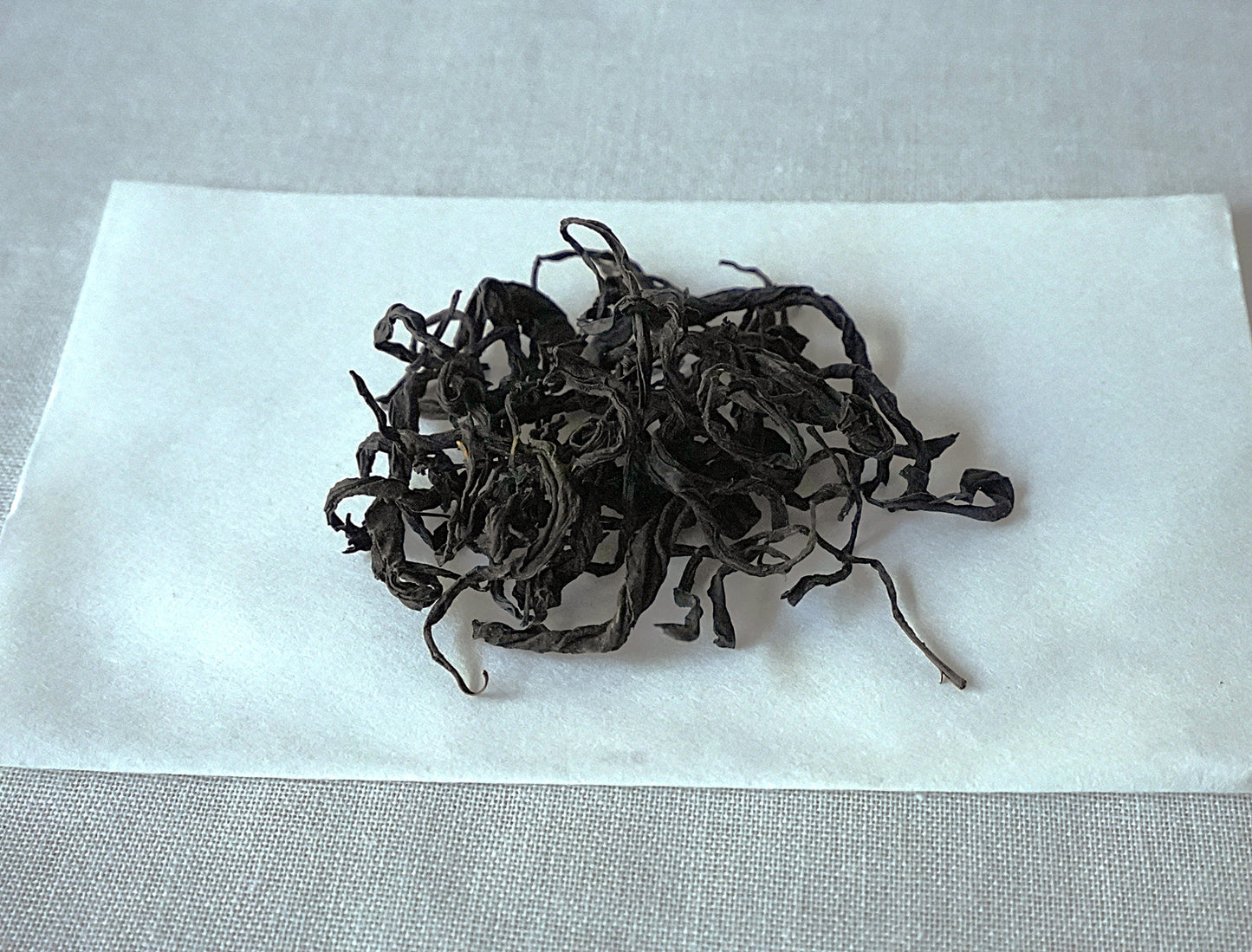
Natural Ecological Black Tea (F4) First Flush
Natural Ecological Black Tea (F4) First Flush
Mie Prefecture has a history of cultivating tea varieties for black tea and exporting them overseas since the Meiji era. It was once a major black tea producing region with the largest production volume in Japan, but with the liberalization of agricultural product imports, production drastically decreased, and now only a few tea farmers produce it.
However, in Kameyama City, which was once the center of black tea production, black tea varieties specifically developed for black tea production in Japan, which were cultivated at that time, still remain in the mountainous areas. F4 is one such black tea variety. As shown in the image, F4 tea trees are not low, slender-trunked shrubs, which are commonly seen, but rather tall trees (kyoboku) with significant height and thick trunks.
It originated from wild mountain tea brought from Taiwan in 1930 and was developed as a variety for black tea. This variety is not found in other prefectures, and its roots trace back to Taiwan during the Japanese colonial period. The "F" in F4 is said to stand for "Formosa," which means "Taiwan" in Portuguese. It has been revealed by the National Taiwan Forest Research Institute that the DNA of Taiwanese wild mountain tea accounts for 50%, and the DNA of small-leaf varieties (not yet identified) accounts for 50%. *Details can be found in the paper published by the National Taiwan Forest Research Institute.
Knowing that F4 remains in the mountainous areas of Kameyama City due to the historical story of black tea connecting Taiwan and Kameyama, we continue to gather information by visiting Taiwanese wild mountain tea and interacting with local black tea farmers. To preserve this history and make it widely known, we manage the F4 tea fields remaining in four locations within the city using natural farming methods and produce F4 black tea by hand-picking.
Place approximately 3g of tea leaves in a gaiwan or teapot of about 150cc, pour in hot water at about 90 degrees Celsius, and steep for about 10 seconds. The key to brewing delicious tea is to thoroughly warm the tea ware with hot water beforehand before adding the tea leaves.
Ingredients: Japanese Tea F4
Natural farming (pesticide-free, chemical fertilizer-free), hand-picked, May 2026
20g
Best before: June 2028
Storage method: Store at room temperature, away from direct sunlight, high temperatures, and high humidity.
Freshness is important for tea. Please consume promptly after opening.
*For orders of 10 bags or more, or for overseas shipping, please inquire.
Couldn't load pickup availability
シェア